


A long patient education video often begins with a reasonable goal: answer the common questions once, accurately and consistently. The result may be comprehensive, but comprehensiveness alone does not create a useful patient experience.
A patient exploring treatment, a patient preparing for a procedure, and a patient recovering at home do not need the same information at the same moment. When every explanation is bundled into one recording, patients must find the relevant section, remember what will matter later, and decide what to do next.
The better approach is not simply to cut the recording at regular intervals. It is to redesign the material as a Patient Education Journey: a clinically governed sequence in which each episode has one purpose, arrives at a relevant point in care, and leads to an appropriate next step.
Start with the pathway, not the runtime
There is no universally correct video length. A concise explanation can still fail if it answers the wrong question, while a longer demonstration may be appropriate when a patient needs to see a process clearly. Runtime should follow purpose.
Before editing the source video, map the practice's actual patient pathway. Depending on the specialty and procedure, that sequence may include:
- Concern and orientation: What issue does this topic address, and why might someone seek an evaluation?
- Consultation preparation: What can the patient learn in advance, and which questions require an individualized discussion?
- Options and expectations: What broad alternatives, tradeoffs, limitations, and next steps should the patient understand?
- Procedure preparation: What practice-approved actions, logistics, and deadlines apply now?
- Recovery and follow-up: What is expected, what instructions should be reinforced, and how should the patient contact the practice with concerns?
The sequence must reflect the practice's real workflow. It should not deliver a preparation instruction before a treatment decision has been made, or present general education as a diagnosis, candidacy determination, or substitute for informed consent.

Give every episode one job
The CDC Clear Communication Index asks communicators to identify the primary audience, communication objective, main message, and intended action. Those questions should be answered for every episode, not only for the collection as a whole.
A useful episode should make it easy to answer four questions:
- Who needs this information?
- What is the single most important message?
- Why is this the right moment to deliver it?
- What should the patient know, ask, or do next?
This creates natural boundaries in the source material. A section explaining treatment options may become one episode; a preparation checklist another; an explanation of normal recovery milestones another. Transitions, repeated context, and calls to action can then be rewritten so each episode stands on its own without changing the approved clinical meaning.
The AHRQ Patient Education Materials Assessment Tool evaluates audiovisual materials for both understandability and actionability. Its criteria include logical sequence, informative headings, familiar language, visual support, and a clear action the user can take. These are practical design requirements for every Journey episode.
Deliver information when it becomes useful
A library makes education available. A Journey makes it timely.
That timing should not depend on a staff member remembering to send the next video. Clarity supports integration-based workflows that connect a Journey to the systems a practice already uses, including its EMR, CRM, or practice-management system. A configured data event can start the appropriate Journey or advance the patient to the next education milestone.
For example, the workflow might use an inquiry, a scheduled consultation, a procedure status, discharge, or a follow-up milestone to trigger the education approved for that stage. The patient can then receive the relevant Journey by text message or another approved channel without requiring the team to manage every delivery manually.
The exact connector, trigger, field mapping, data flow, delivery channel, and implementation scope are confirmed with each practice during onboarding. The goal is to map education to meaningful events in the practice's workflow—not to move more patient data than the workflow requires.
A systematic review of patient education delivered through smartphones and tablets found that mobile delivery can support timely education and highlighted timing and frequency as important design considerations. That does not establish one schedule for every patient or procedure. It does support a more deliberate question: when will this particular explanation help the patient prepare, decide, or act?
For example, an orientation episode may be useful before the consultation. A logistics episode may belong after scheduling. A recovery episode may be delivered before the procedure and reinforced again when those instructions become immediately relevant. The practice should determine the sequence, timing, repetition, and escalation paths according to its clinical and operational policies.
Use video for what video does well
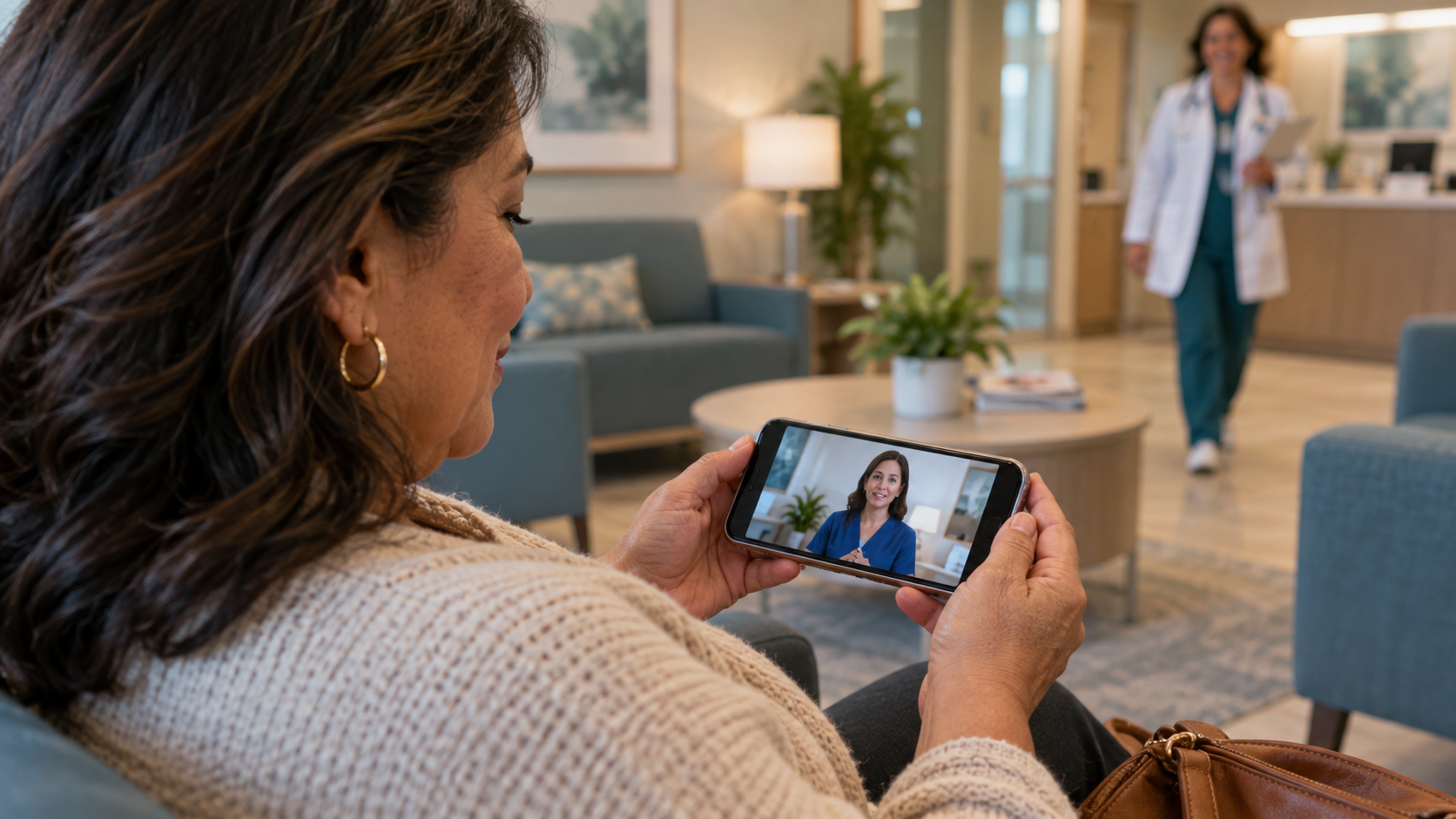
Video can combine spoken explanation, a human face, demonstration, graphics, and story. That can make unfamiliar information feel more approachable and give patients a concrete frame for what happens next.
The evidence still calls for disciplined expectations. A 2023 systematic review of video-based education for people with chronic illnesses found robust improvement in knowledge, while effects on disease severity and health care use were less consistent; many included studies also had moderate or high risk of bias. Practices should therefore treat knowledge and preparation as meaningful goals without promising that video alone will change behavior or clinical outcomes.
Clarity uses a person as the host of each video—an Educational Avatar or an authorized Provider Digital Twin—so the education remains human-centered. Storytelling can help the viewer follow a situation, recognize a question, and project themselves into the patient experience. The story should serve the learning objective, not dramatize risk or replace balanced clinical explanation.
Protect the clinical source as the content changes
Restructuring one source into many episodes creates more assets to govern. The practice needs a traceable relationship between each finished episode and the approved source.
For every episode, retain:
- the source script and clinical references;
- the audience, purpose, and point in the patient pathway;
- the exact approved narration, visuals, captions, and on-screen language;
- the clinical reviewer, approval date, and version;
- the delivery workflow and responsible owner; and
- the review or replacement process when evidence, instructions, or practice policy changes.
Clinical review should cover the finished episode, not merely the original long-form script. Editing can change emphasis, context, sequence, or the apparent relationship between a statement and an image. Approval must apply to the version the patient will actually receive.
Close the loop in the consultation
Journey analytics can show permitted operational signals such as whether assigned content was delivered or opened, depending on the configured system. Those signals do not prove comprehension, informed consent, or treatment readiness.
The care team still needs a human check. AHRQ's teach-back guidance recommends asking patients to explain information or actions in their own words and clarifying as needed. A Journey can prepare the conversation and make repeated education more consistent; the clinician remains responsible for applying general information to the individual patient.
How Clarity turns source content into a Journey
Clarity helps specialty practices move from a single comprehensive explanation to a connected education experience. Our purpose-trained, agentic script writer is grounded in peer-reviewed clinical content developed with a medical advisory board of board-certified surgeons and specialty key opinion leaders. The practice adapts that foundation to its approach and approves the exact content.
Clarity AI Studio then produces human-hosted videos using an Educational Avatar or an authorized Provider Digital Twin. The Clarity Patient Education Platform organizes the approved episodes into Journeys. Through a configured EMR, CRM, practice-management, appointment, form, or other supported workflow event, the Platform can deliver the relevant Journey when the patient reaches the corresponding milestone.
The result is not a pile of shorter videos. It is a governed sequence designed to help patients build understanding over time while preserving the clinician's role in individual judgment, questions, and informed decision-making.
Bring one long-form video, presentation, or priority procedure to a Clarity demo. We'll show you how it can become a connected Patient Education Journey.
Book a DemoSources
- Centers for Disease Control and Prevention: How to Use the Clear Communication Index
- Agency for Healthcare Research and Quality: Patient Education Materials Assessment Tool
- Agency for Healthcare Research and Quality: Use the Teach-Back Method
- Müller and colleagues: Timely delivery of patient education with smartphones and tablets—systematic review
- Win and colleagues: Video-based educational interventions for people with chronic illnesses—systematic review